

Machine learning is one of those subjects that can look simple from a distance and surprisingly confusing once you try to learn it.
You start with a tutorial. Then you hear about Python, pandas, NumPy, statistics, neural networks, TensorFlow, PyTorch, transformers, and large language models. Before long, you’re saving dozens of tutorials without finishing the first one.
The problem usually isn’t a lack of resources. It’s the order in which you learn them.
If you want to start machine learning the right way, you don’t need to begin with neural networks or learn every popular AI framework. Start by understanding how data becomes a prediction, how a model learns from examples, and how you can tell whether that model is actually doing a good job.
This guide walks through that process step by step.
What You’ll Learn in This Guide
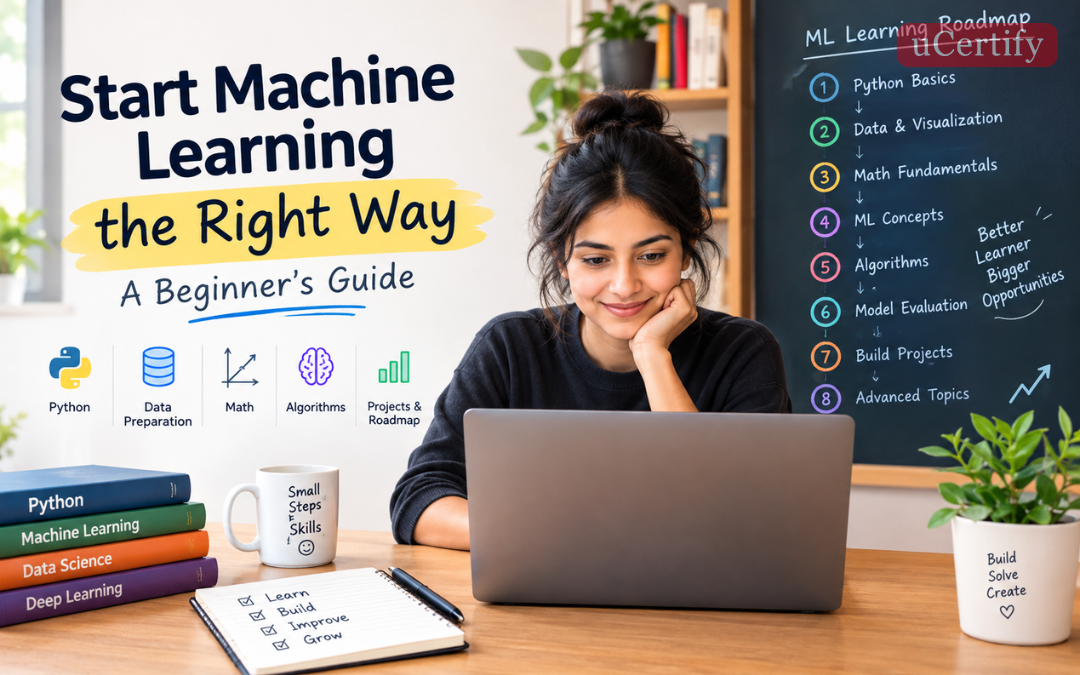
Start Machine Learning the Right Way
By the end of this beginner machine learning guide, you should be able to:
- Explain what machine learning actually does.
- Understand features, targets, training, validation, and testing.
- Distinguish classification, regression, and other major learning approaches.
- Understand why data preparation matters.
- Recognize overfitting and data leakage.
- Choose useful evaluation metrics.
- Plan a realistic first machine learning project.
- Understand what to learn before moving into deep learning.
You don’t need an advanced mathematics background to begin. You need curiosity, some Python fundamentals, and a willingness to experiment.
What Is Machine Learning?
At a basic level, machine learning allows a computer system to find patterns in data and use those patterns to make predictions or decisions.
Consider spam filtering.
Instead of writing a rule for every possible spam message, a machine learning system can learn from examples of messages that have already been identified as spam or legitimate. It may examine words, links, sender information, message structure, and other signals.
When a new message arrives, the trained model uses what it learned to estimate which category the message belongs to.
That’s the basic idea.
Traditional programming is often represented as:
Rules + Data → Output
Machine learning is commonly thought of as:
Examples + Expected Outcomes → Learned Model
The distinction is important. You aren’t simply telling the computer every rule it should follow. You’re giving it data from which it can learn a useful pattern.
But there’s a catch.
A model can find patterns that are useful, irrelevant, or even misleading. That’s why machine learning isn’t just about training a model. You also need to know how to prepare data, evaluate predictions, and recognize when the model is fooling you.
Why Beginners Often Get Stuck
Many people begin machine learning by jumping directly into an algorithm.
They open a notebook, load a dataset, run a few lines of Python, and suddenly see:
Accuracy: 94%
It feels like progress.
Then they try a different dataset and have no idea why the result changes.
This happens because knowing how to run an algorithm isn’t the same as understanding machine learning.
Before worrying about which algorithm is the newest or most powerful, you should understand a few basic questions:
- What information is the model receiving?
- What is it trying to predict?
- What examples is it learning from?
- How is its performance being measured?
- Is it learning a useful pattern or simply memorizing the training data?
Those questions form the foundation of the subject.
Step 1: Get Comfortable With Python
You don’t need to become a professional Python developer before starting machine learning.
You do need enough Python knowledge to work with data without constantly stopping to figure out basic syntax.
Start with:
- Variables and data types
- Lists, tuples, and dictionaries
- Conditions and loops
- Functions
- Importing modules
- Reading files
- Basic error handling
- Simple classes and objects
Then move into the tools you’ll use when working with datasets.
NumPy
NumPy provides efficient ways to work with numerical arrays and mathematical operations.
pandas
pandas is particularly useful for loading, filtering, cleaning, and inspecting tabular datasets.
Matplotlib
Matplotlib helps you visualize information.
That matters because a table of numbers doesn’t always reveal a pattern clearly.
Imagine a dataset containing house sizes and selling prices. A scatter plot may immediately show that larger houses tend to sell for more, while also revealing unusual properties that don’t follow the general trend.
That’s much easier to notice visually than by scanning hundreds of rows.
Don’t Overdo Python First
One common mistake is spending months learning Python before touching a machine learning problem.
You don’t need to know every Python feature.
Learn enough to work with data, then strengthen your programming skills as your projects demand it.
Step 2: Learn the Math You Actually Need
The word math can make machine learning sound harder than it is.
You don’t need to memorize advanced formulas before building your first model. But understanding some mathematics will eventually help you understand what the model is doing instead of treating it like a black box.
Start with three areas.
Statistics
Learn concepts such as:
- Mean and median
- Variance and standard deviation
- Probability
- Distributions
- Correlation
- Sampling
For example, if you’re examining customer activity, the average number of monthly logins can tell you something about typical behavior. Standard deviation can tell you how spread out those values are.
Linear Algebra
Start with:
- Vectors
- Matrices
- Dimensions
- Basic matrix operations
These concepts appear frequently when data is represented numerically.
Calculus
You don’t need advanced calculus on day one.
Later, concepts such as derivatives and gradients become useful when you learn how models are optimized.
The important question isn’t:
“Can I memorize this formula?”
It’s:
“What does this mathematical idea help the model do?”
That mindset makes math much easier to connect with machine learning.
Step 3: Understand the Main Types of Machine Learning
Before studying individual algorithms, understand the bigger picture.
Supervised Learning
In supervised learning, the training examples include the outcome you want the model to learn.
Imagine you’re trying to predict whether a customer will cancel a subscription.
Your dataset might contain:
- Months as a customer
- Monthly usage
- Subscription type
- Number of support requests
- Previous activity
And the target could be:
Churn: Yes or No
The model learns from previous examples and then makes predictions for customers it hasn’t seen before.
Two common supervised learning tasks are classification and regression.
Classification
Classification predicts a category.
Examples:
- Spam or not spam
- Fraud or legitimate
- Customer churn or no churn
Regression
Regression predicts a numerical value.
Examples:
- House price
- Sales revenue
- Delivery time
- Temperature
That distinction is simple, but learning it early prevents a lot of confusion later.
Unsupervised Learning
In unsupervised learning, the dataset doesn’t provide a predefined answer for every example.
The model looks for patterns within the data.
For example, a retailer could analyze customer behavior and discover groups of customers with similar purchasing habits.
Clustering is one common approach.
The important point is that you’re asking the system to discover structure, rather than predict a known target.
Reinforcement Learning
Reinforcement learning works differently again.
An agent interacts with an environment and receives rewards or penalties based on its actions. Over time, it learns strategies that can improve its results.
This approach appears in areas such as robotics, games, and certain decision-making systems.
You don’t need to master reinforcement learning at the beginning.
For most people starting their machine learning journey, supervised learning provides a more approachable entry point.
Step 4: Understand What a Model Actually Learns
Let’s return to the customer-churn example.
Suppose you have thousands of previous customers.
For each customer, you know things such as:
| Feature | Example |
| Months as customer | 18 |
| Monthly usage | 42 hours |
| Support requests | 2 |
| Subscription type | Premium |
| Churned | No |
Here, the first four columns are featured.
The final column is the target.
During training, the model examines many examples like these and attempts to learn relationships between the features and the target.
Later, you give the model information about a new customer:
5 months as a customer, 8 hours of monthly usage, 7 support requests, basic subscription.
The model produces a prediction.
Perhaps:
Predicted churn: Yes
That doesn’t mean the model knows the customer personally or understands why they might leave. It has identified patterns in the training data that it uses to make an estimate.
This distinction is important.
Machine learning produces predictions from learned patterns. It does not automatically produce understanding.
Step 5: Learn the Training, Validation, and Test Process
Here’s one of the most important ideas in machine learning:
Don’t judge a model only by how well it performs on data it has already seen.
Imagine preparing for an exam by memorizing every question in advance.
You could score extremely well.
But give you a different set of questions and the result might be very different.
Machine learning models can have a similar problem.
A dataset is therefore commonly divided into separate parts.
Training Data
The model uses this data to learn.
Validation Data
Validation data can be used while developing the model to compare approaches and tune choices.
Test Data
The test set is held back for a final evaluation of the chosen approach.
The exact setup varies depending on the problem. Some workflows use cross-validation instead of maintaining a separate validation set, particularly when the dataset is relatively small.
The principle remains the same:
A model should work on new data, not just remember the examples it was given.
Overfitting: When a Model Learns Too Much
Overfitting is one of the first machine learning concepts that really changes how you think about model performance.
Imagine you’re trying to recognize cats from photographs.
A useful model should learn characteristics that help distinguish cats from other animals.
An overfitted model might instead become overly dependent on details that happen to appear in its training images—perhaps a particular background, camera angle, or other accidental feature.
It performs extremely well on training examples but struggles with new ones.
You can think of the three situations like this:
Underfitting: The model hasn’t learned enough.
Good generalization: The model has learned useful patterns that work on new data.
Overfitting: The model has learned the training examples too closely.
This is why a model with a very high training score isn’t automatically impressive.
The real question is:
How does it perform on data it hasn’t seen before?
Step 6: Don’t Skip Data Preparation
This is the part of machine learning that beginners sometimes underestimate.
Real-world data is rarely clean.
You may find:
- Missing values
- Duplicate records
- Incorrect entries
- Outliers
- Different date formats
- Text values that need encoding
- Imbalanced classes
- Columns that shouldn’t be used
Suppose a dataset contains an age of:
250
A machine learning algorithm isn’t automatically going to stop and say, “That looks suspicious.”
You have to investigate the data and decide what should happen.
This is why a realistic machine learning workflow looks more like:
Understand → Clean → Explore → Prepare → Train → Evaluate → Improve
rather than:
Load dataset → Run algorithm → Done
In many real projects, understanding the dataset can take more effort than writing the model-training code.
Watch Out for Data Leakage
There’s another problem beginners should know about: data leakage.
Data leakage happens when information that shouldn’t be available during prediction accidentally gets into the training process.
Imagine you’re building a model to predict whether a patient will be readmitted to a hospital.
If you accidentally include information that is only recorded after the patient’s discharge, the model may appear extremely accurate during development.
But that information wouldn’t actually be available when you needed to make the prediction.
The model isn’t magically intelligent.
The evaluation was flawed.
This is why you should always ask:
Would this information genuinely be available at the moment the prediction is supposed to happen?
That simple question can prevent serious mistakes.
Step 7: Learn Algorithms One at a Time
You don’t need to memorize dozens of machine learning algorithms.
Start with a manageable group and understand what each one is trying to accomplish.
A useful beginner sequence is:
- Linear Regression
- Logistic Regression
- Decision Trees
- Random Forests
- k-Nearest Neighbors
- Support Vector Machines
- Basic clustering methods
Don’t learn them as a list of definitions.
For every algorithm, ask:
- What type of problem does it solve?
- What kind of data can it handle?
- What assumptions does it make?
- How do I measure its performance?
- What can go wrong?
For example, Linear Regression can be used when you’re predicting a continuous numerical outcome and want to model relationships between variables.
A Decision Tree takes a different approach, making a sequence of decisions based on feature values.
You don’t need to decide which algorithm is “the best” in general.
There isn’t one universal winner.
The appropriate choice depends on the dataset, problem, constraints, and evaluation criteria.
Step 8: Build a Baseline Before Chasing Better Models
Here’s a habit worth developing early:
Start with something simple.
Suppose you’re predicting customer churn.
Before experimenting with increasingly complicated models, establish a baseline.
For a classification problem, a simple baseline might predict the most common class for every example.
It probably won’t be impressive.
That’s fine.
Its purpose is to give you a reference point.
If your sophisticated model performs only slightly better than the baseline, that’s useful information. It tells you that simply adding complexity isn’t necessarily solving the problem.
This habit also changes the way you think about machine learning.
Instead of asking:
“How advanced is my model?”
you start asking:
“Does my model actually improve the result?”
That’s a much more useful question.
Step 9: Learn From Your Model’s Mistakes
Suppose your classifier achieves 90% accuracy.
At first glance, that sounds good.
But imagine that 90% of your dataset belongs to one class.
A model that predicts the majority class every time could achieve 90% accuracy without learning anything useful about the minority class.
That’s why evaluation needs context.
Depending on the problem, you may need to examine:
- Accuracy
- Precision
- Recall
- F1-score
- Confusion matrix
- Mean Absolute Error
- Mean Squared Error
The appropriate metric depends on what you’re predicting.
For example, in a fraud-detection system, you may care about finding fraudulent transactions while controlling the number of legitimate transactions incorrectly flagged.
In a regression problem such as house-price prediction, classification metrics like precision and recall aren’t appropriate. You would instead look at measures of prediction error.
The metric should follow the problem—not the other way around.
Step 10: Build Your First Small Project
This is where the ideas become real.
Don’t wait until you know every algorithm.
Pick a problem small enough to finish.
Example: Build a House Price Prediction Project
Imagine you have a dataset containing:
- House size
- Number of bedrooms
- Number of bathrooms
- Property age
- Location
- Selling price
Your goal is to predict the selling price.
Step 1: Understand the Dataset
Look at the columns.
How many rows are there?
Are values missing?
Are any values obviously incorrect?
Step 2: Explore the Data
Look for relationships.
Does house size appear related to price?
Are some locations significantly different?
Are there unusual properties?
Step 3: Choose Features and Target
Features might include:
- Size
- Bedrooms
- Bathrooms
- Age
- Location-related variables
Target:
Selling price
Step 4: Split the Data
Set aside data that won’t be used to train the model.
Step 5: Train a Simple Model
Start with something straightforward, such as a regression model.
You don’t need the most complicated algorithm for your first attempt.
Step 6: Evaluate It
Compare the predicted prices with the actual prices.
How large are the errors?
Are some types of houses predicted particularly poorly?
Step 7: Improve It
Now you have questions worth investigating.
Maybe location needs better representation.
Maybe extreme properties are affecting the model.
Maybe some features are unnecessary.
Maybe another algorithm performs better.
This is the real learning experience.
You aren’t simply following a tutorial anymore. You’re making decisions based on what you observe.
What Should You Learn Before Building Bigger Projects?
Once you’ve completed a few small projects, you can gradually expand your toolkit.
A sensible progression is:
Foundation
- Python
- NumPy
- pandas
- Data visualization
- Basic statistics
Core Machine Learning
- Regression
- Classification
- Clustering
- Model evaluation
- Feature engineering
- Cross-validation
- Overfitting
- Data leakage
Practical Skills
- Working with real datasets
- Experiment tracking
- Model comparison
- Data preprocessing
- Communicating results
Advanced Areas
Once the fundamentals feel comfortable, you can choose a direction such as:
- Deep learning
- Natural language processing
- Computer vision
- Generative AI
- Recommendation systems
- Time-series forecasting
- Reinforcement learning
You don’t have to learn every branch.
Machine learning is too broad for that to be a sensible beginner goal.
Choose an area based on the kinds of problems you want to solve.
A Simple Machine Learning Roadmap for Beginners
If you want a straightforward machine learning roadmap, use this as a starting point:
Stage 1 — Python
Learn enough Python to manipulate data and write simple programs.
↓
Stage 2 — Data
Learn NumPy, pandas, visualization, and basic data cleaning.
↓
Stage 3 — Mathematics
Build practical knowledge of statistics, probability, and linear algebra.
↓
Stage 4 — Fundamentals
Understand supervised, unsupervised, and reinforcement learning.
↓
Stage 5 — Core Algorithms
Learn regression, classification, trees, and clustering.
↓
Stage 6 — Evaluation
Study train/test splits, cross-validation, metrics, overfitting, and data leakage.
↓
Stage 7 — Projects
Build several small projects using real datasets.
↓
Stage 8 — Specialization
Choose deep learning, NLP, computer vision, generative AI, or another area.
Think of this as a map rather than a strict curriculum. You will probably move backward occasionally when a project exposes something you don’t understand yet.
That’s normal.
Common Machine Learning Mistakes Beginners Make
Trying to Learn Everything at Once
Python, statistics, TensorFlow, PyTorch, NLP, computer vision, LLMs…
It’s easy to turn learning into a collection of unfinished tutorials.
Choose one small goal and finish it.
Copying Code Without Understanding It
A tutorial can produce a working model in minutes.
That doesn’t mean you understand the model.
After following an example, change something.
Remove a feature. Try a different model. Change the evaluation metric. Inspect an incorrect prediction.
If you can explain what changed and why, you’re learning.
Ignoring the Dataset
A sophisticated algorithm cannot automatically rescue poor-quality data.
Spend time understanding where the data came from and what each column actually represents.
Chasing Accuracy
A higher accuracy number isn’t automatically a better result.
Look at the actual problem and choose evaluation measures that reflect what matters.
Starting With an Overly Complicated Project
Your first project doesn’t need to involve an LLM, real-time predictions, cloud deployment, and five different frameworks.
A small project that you completely understand is more valuable than a huge project assembled from copied code.
Waiting Until You Feel Ready
You won’t know everything before your first project.
Your first project will probably expose gaps in your knowledge.
That’s not a sign that you failed.
Those gaps tell you what to learn next.
5 Things to Remember Before You Move On
If you remember only a few ideas from this guide, remember these:
1. A model learns from examples
It identifies patterns in training data and uses them to make predictions.
2. Features and targets are different
Features provide information to the model. The target is what you’re trying to predict.
3. Training performance isn’t enough
A useful model needs to perform well on data it hasn’t seen before.
4. Data quality matters
Missing values, incorrect records, leakage, and poorly chosen features can undermine an otherwise good model.
5. Projects teach you what tutorials can’t
Building something forces you to make decisions, investigate errors, and understand why a model behaves the way it does.
So, How Should You Start Machine Learning?
Don’t begin with:
“Which AI framework should I learn?”
Begin with:
“What problem can I solve with data?”
Then work backward.
Learn enough Python to handle the data. Understand the basic mathematics. Learn how features become predictions. Build a small model. Test it on data it hasn’t seen. Look at where it fails. Improve it.
Then repeat the process.
You don’t need to understand neural networks before building your first useful machine learning project. You don’t need to memorize every algorithm. And you certainly don’t need to finish every machine learning tutorial on the internet.
Start with the fundamentals. Build something small. Investigate what goes wrong. Let each project tell you what to learn next.
That’s a much more sustainable way to learn machine learning from scratch—and a far better starting point than trying to learn everything at once.



No Comments Yet
Be the first to share your thoughts on this post!